Building scalable AI systems, APIs & cloud pipelines.
AI Engineer & Software Engineer specializing in production machine learning systems, schema-aware LLM/RAG microservices, robust backend APIs, and distributed cloud-connected IoT infrastructure. Undergraduate in B.Tech CSE (AI & ML) at Vellore Institute of Technology.
Target Roles:
AI / ML EngineerSoftware DeveloperBackend / API EngineerCloud EngineerForward Deployed Engineer
Lead Engineer · SEED Project 10 Raspberry Pis · 604,800 AWS IoT Ingestions
5 Published Indian Patents Edge AI, Precision Agriculture & Biosignals
Technical Competencies
Systems-driven engineering stack.
Organized across eight core engineering domains. Every technology listed is backed by verified production implementations, open-source pull requests, published patents, or validated research systems.
AI/ML and Model Development
Deep learning, statistical modeling, computer vision, acoustic representations, and temporal forecasting.
▸Engineered an automated Computer Vision + Multimodal-LLM architectural floor-plan pipeline using EasyOCR, OpenCV, YOLO, Hough Transform, and Gemini to extract structural wall geometry and room boundaries into a validated Building Semantic Model across 8 engineering-agent contexts.
▸Developed the HVAC intelligence layer over spatial geometry, thermal zones, openings, wall materials, adjacency graphs, and airflow topology, generating structured context for downstream mechanical engineering reasoning.
▸Architected a schema-aware NL-to-SQL WMS assistant using FastAPI, LlamaIndex, BGE-small vector embeddings, and Llama-3-8B over a 4-sheet operational schema, implementing intent classification, entity resolution, SQL generation, validation, and session state.
▸Engineered the React/TypeScript + Supabase/PostgreSQL web application following Repository–Service–Hook–Component design patterns with Row-Level Security (RLS), protected routes, and signed-URL document storage.
KRG Technologies Inc.
Python Developer Intern
Jun 2025 – Jul 2025Chennai, India (On-Site)
System Focus: High-Throughput AI Resume-Intelligence & Document Processing Pipeline
2,000+ Resumes Validated
95–99% Core-Field Accuracy
85–90% Screening Overhead Reduction
<200ms API Search Latency
Systems & Implementations Delivered:
▸Engineered an AI resume-intelligence pipeline benchmarked and validated on 2,000+ resumes across 7+ document formats, combining native text extraction and vision OCR with 95–99% core-field extraction precision.
▸Architected 25-field LLM extraction using Gemini, strict JSON/schema validation, entity normalization, and Flask microservices, integrating Mammoth, Anti-Word, and Affinda for 50 ms – 1 s document parsing.
▸Developed interactive React + Flask workflows for individual and bulk candidate ingestion and recruiter search across 20+ candidate attributes, reducing manual screening overhead by 85–90% with <200ms API latency.
▸Built resilient file validation pipelines handling malformed PDFs, scanned image resumes, and unstructured tables with comprehensive fallback parsers.
MEDxAI Innovations Private Limited
Machine Learning Intern
May 2025 – Aug 2025Chennai, India (Hybrid)
System Focus: Pharmacogenomics AI/ML Pipeline & Clinical Dosage Decision Engine
CPIC Guideline Rules Mapped
Multi-Source Genomic Integration
Deterministic + ML Hybrid Decision Engine
Systems & Implementations Delivered:
▸Engineered an end-to-end pharmacogenomics AI/ML pipeline integrating PharmGKB clinical annotations, variant–drug associations, phenotype records, drug labels, and CPIC guidelines to analyze gene–variant–drug interactions.
▸Developed a hybrid pharmacogenomic decision framework combining evidence-based knowledge retrieval with ML inference for both annotated and novel variant interactions.
▸Built a drug-dosage intelligence engine transforming raw FDA labels and CPIC guidelines into machine-readable dosage recommendations and probabilistic risk categories.
▸Constructed modular prediction and reporting microservices for phenotype classification, clinical evidence retrieval, and personalized outcome scoring via REST endpoints.
Open-Source Engineering
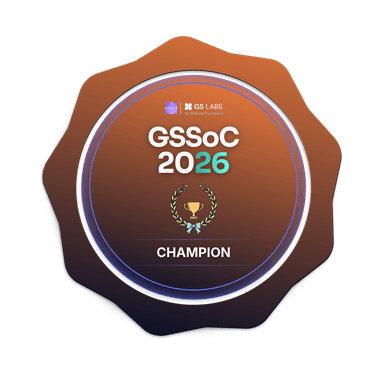
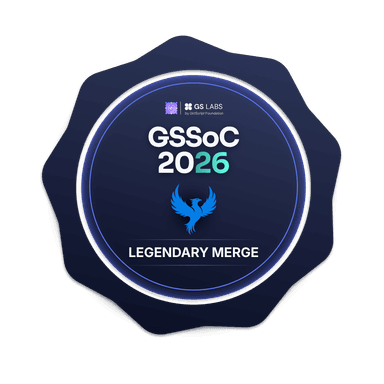
GSSoC 2026 — Top 1% global contributor.
Ranked #80 globally out of 43,587 international developers in GirlScript Summer of Code 2026. Merged 179 pull requests across 7 production repositories spanning autonomous AI agents, streaming backend APIs, and full-stack software tooling.
GSSoC 2026 Official Rank: #80 Globally (Top 1%) · Ranked #2 @ Vellore Institute of Technology
Production AI Agent Workflows, Real-Time Streaming & Backend Hardening
Contributed across full-stack repositories with production Next.js, Python, FastAPI, and Node.js architectures. Engineered multi-turn agent state management, validated structured JSON outputs against runtime schemas, built real-time Server-Sent Events (SSE) inference pipelines, and fortified API endpoints with concurrency locks, rate limiting, and automated CI test validation.
Implemented directed agent execution workflows, structured-output validation using strict Pydantic/Zod schemas, and session memory persistence across multi-turn agent interactions in Next.js and Python.
Next.jsPythonFastAPIPydanticAI Agents
API & Backend Engineering
Real-Time Streaming APIs via Server-Sent Events (SSE)
Engineered resilient Server-Sent Events (SSE) endpoints in FastAPI and Node.js for ultra-low latency token streaming and intermediate agent reasoning thought traces to client web applications.
FastAPIServer-Sent EventsNode.jsAsyncIO
Security & Microservices
Backend API Hardening, Concurrency & Rate Limiting
Hardened backend API routes with JWT authentication guards, token-bucket rate limiters, concurrent transaction locks, unified error middleware, and cache consistency mechanisms across server actions.
Next.js Server ActionsJWTRate LimitingTypeScript
DevOps & Quality Engineering
Code Quality, Security Validation & CI Test Coverage
Added automated integration test suites, input sanitization middleware against prompt injection vulnerabilities, and strict schema contracts across 7 public open-source repositories.
JestPytestInput SanitizationGitHub Actions
Engineering Leadership & Community Mentorship
NEXUS VIT
AI/ML Technical Team Member · Sep 2024 – Present
Architected the official NEXUS conversational AI chatbot system for student query resolution, event registrations, and campus technical workshops.
Tech Researchers Club VIT
R&D Member & Engineering Mentor · Sep 2024 – Present
Mentored junior engineering members in experimental design, dataset benchmarking, code review standards, and reproducible ML pipeline workflows.
Institutional SEED-Funded Initiative
Next-Gen precision IoT irrigation system.
An applied cyber-physical engineering initiative combining distributed edge sensing, encrypted cloud telemetry, deep learning forecasting, and automated valve actuation across the Vellore Institute of Technology campus.
Funded Field Project LeadVellore Institute of Technology (On-Site Funded Field Project)Aug 2025 – Present
Next-Gen Irrigation: Leveraging Machine Learning for Precision Water Delivery at VIT
Led a 14-member multidisciplinary engineering team across 8 workstreams to build and deploy an end-to-end intelligent IoT sensing network, cloud ingestion pipeline, and ML-driven precision water delivery system.
14Engineers LedAcross 8 Technical Workstreams
10 UnitsRaspberry Pi Edge Nodes
Custom 3D-printed weather-resistant enclosures with 7 sensing channels each.
604,800Sensor Observations
Captured over 90 continuous days at 15-minute telemetry intervals.
4 PatentsPublished Indian Patents
Derived from hardware architecture, telemetry pipelines, and predictive algorithms.
99.4%Cloud Telemetry Uptime
MQTT to AWS IoT Core pipeline with local edge caching fallback.
End-to-End Cyber-Physical Architecture & Data Flow
AWS Cloud + Hardware In-the-Loop
01. Sensing EdgeRaspberry Pi 47-channel environmental & soil telemetry
02. ProtocolMQTT / JSON15-min payload encryption & local caching
▸Architected the Raspberry Pi firmware telemetry client with local SQLite buffer caching to guarantee zero data loss during intermittent campus Wi-Fi outages.
✓10 field Raspberry Pi IoT units with multi-depth soil moisture, temperature, humidity, pH, and ambient sensors
✓High-frequency 15-minute telemetry interval with automated schema validation and outlier filtering
✓AWS IoT Core to EC2 Flask microservice data pipeline secured with JWT access tokens
✓Automated cloud alerting via CloudWatch for sensor failures or communication dropouts
✓Predictive deep learning models driving automated solenoid valve relays
Applied Research & Development
Algorithms, pipelines & statistical rigor.
Reframing academic research as applied computational engineering: developing production-grade machine learning pipelines, formal sequence models, dataset harmonization suites, and empirical evaluation frameworks across international research collaborations.
Research Engineer InternCNI – QNeuro – SUNY Binghamton Research Program
Cognitive Grammar Learning Framework for Biosignal Telemetry
Centre for Neuroinformatics (CNI), Vellore Institute of Technology · Chennai, India (Hybrid)
May 2026 – Jul 2026Focus: Converting continuous multimodal physiological streams (ECG + EDA) into discrete symbolic state machines and sequence learning architectures.
Program Affiliations:
SUNY Binghamton
Vellore Institute of Technology
QNeuro
34 Human Participants Evaluated via LOSO
637 Synchronized 10-s Biosignal Windows
5-State Symbolic Grammar Discovered
Statistically Validated via BCa Bootstrap & ECE
Engineering Implementations & Algorithmic Design:
▸Developed an end-to-end signal processing pipeline converting multimodal ECG and EDA streams into a 5-state symbolic vocabulary via Gaussian Mixture Models (GMM) with Bayesian Information Criterion (BIC) state selection.
▸Engineered a Bidirectional GRU (BiGRU) sequence learning architecture to model cognitive state transition dynamics; harmonized CL-Drive and CLARE benchmarks into 637 synchronized 10-second windows with 629 verified samples.
▸Engineered automated signal normalization, latent-state discovery, grammar induction, and sequence-learning pipelines, systematically evaluating 34 participants using Leave-One-Subject-Out (LOSO) and cross-dataset transfer.
▸Engineered comprehensive model explainability and statistical validation suites using Gradient Saliency, Integrated Gradients, Expected Calibration Error (ECE), PCA, BCa bootstrap confidence intervals, Shapiro–Wilk normality testing, and jackknife sensitivity metrics.
▸Developed a multi-corpus Speech Emotion Recognition (SER) framework harmonizing diverse speech utterances from four major international benchmarks: RAVDESS, CREMA-D, TESS, and SAVEE.
▸Engineered a lightweight 1D-Convolutional Neural Network (1D-CNN) with 7.19M parameters over Mel-Frequency Cepstral Coefficients (MFCC), Zero-Crossing Rate (ZCR), and Root Mean Square Energy (RMSE) acoustic features, achieving 98.03% accuracy and 0.980 Macro-F1.
▸Conducted rigorous Leave-One-Dataset-Out (LODO) cross-corpus transfer evaluations and additive Gaussian noise stress tests to quantify boundary robustness across acoustic recording environments.
▸Demonstrated cross-corpus generalization via ablation and statistical analysis; transfer learning improved performance by +5.05 pp (p < 0.001), while isolating the critical role of Batch Normalization, whose removal caused a 79.84 pp accuracy drop due to internal covariate shift.
Real-time autonomous vehicle policy training typically requires heavy C++ or GPU runtimes while operating as uninspectable black boxes, failing to provide safety engineers with live spatial decision boundaries or verifiable neural weights.
What I Personally Implemented
Engineered DriveGraph, a zero-dependency autonomous vehicle simulation platform in modern Vanilla JavaScript and HTML5 Canvas 2D running at 60 FPS in-browser; parses OpenStreetMap (OSM) GIS road graphs via Overpass API, computes Minkowski road surface envelopes, casts 15 LiDAR-like 360° ray beams, visualizes 2D hyperplane decision boundaries, and evolves sparse neural controllers.
▸Engineered a zero-dependency 60 FPS browser runtime with O(1) spatial hashing collision detection, eliminating external graphics libraries and C++ bindings.
▸Developed a live white-box Explainable AI cockpit computing high-resolution (300×300) 2D hyperplane slices across input sensor dimensions, color-coding steering/throttle margins in real time.
▸Evolved neural network topologies across 50 policies × 100 generations × 10 episodes; expanded connections from 45→78 (56% growth) under held-out-map evaluation with deterministic Time-to-Collision (TTC) safety overrides.
Severe 3-phase load imbalance across electrical distribution networks causes catastrophic transformer overloads, 5–8% energy loss spikes, and line outages due to uncoordinated manual phase switching during peak hours.
What I Personally Implemented
Built a 3-layer edge-cloud control system connecting ESP32 household nodes, Raspberry Pi transformer controllers, and HQ analytics servers; integrated RS-485/Modbus, LoRa wireless mesh, and MQTT/TLS with autonomous edge decision-making, zero-crossing detection, relay interlocks, and dual-stage cryptographic authorization.
Technical Architecture & Data Flow:Distributed Edge-to-Cloud Grid Control Pipeline
Home Node 3-Phase Busbar Sensing (PZEM-004T / EM-10 Meters)
▸Selected as Top 30 Hardware Teams nationwide out of 850+ campus teams in Smart India Hackathon 2025 (KSEB Problem Statement 25064).
▸Engineered hardware-level safety interlocks: enforced zero-crossing switching, voltage-health verification, and minimum-switch-interval delays before activating physical 3-phase relays.
▸Architected local edge autonomy allowing transformer controllers to cache policies in SQLite and balance loads locally without communication loss during grid network partitions.
Commercial cloud AI tools transmit sensitive legal inquiries to external third-party servers, produce ungrounded hallucinations, and lack verifiable statutory citations required for criminal law research.
What I Personally Implemented
Architected LexBNS, an enterprise-grade, 100% offline Retrieval-Augmented Generation (RAG) and ReAct reasoning engine; pairs local Ollama models (Llama 3.1 8B / Mistral 7B) with dense FAISS vector search over statutory PDFs (Bharatiya Nyaya Sanhita 2023 & Constitution of India); containerized via Docker Compose with a Streamlit interface featuring expandable source citation drawers.
Technical Architecture & Data Flow:Offline Ingestion, Vector Search & Local ReAct Execution
Official Statutory PDF Ingestion & Recursive Character Chunking (800 tok / 200 overlap)
Local Ollama Inference Engine (Llama 3.1 8B / Mistral 7B via GPU acceleration)
Streamlit UI with Live Ollama Daemon Status & Statutory Citation Drawers
Key Engineering Challenges & Trade-Off Decisions:
▸Guaranteed strict data privacy and zero cloud telemetry by hosting model weights locally on-premise, eliminating recurring API costs and vendor lock-in.
▸Prevented hallucination through strict FAISS retrieval constraints: the LLM is prohibited from synthesizing ungrounded statutes, enforcing direct statutory section verification.
▸Engineered expandable citation drawers displaying exact legal text excerpts alongside answers for instantaneous verification by legal professionals.
04Speech Representation Learning · Disentanglement · Healthcare AI
Lead Deep Learning Engineer (Final Year B.Tech Project-1)May 2025 – Jul 2025
HEDER-Net: Hierarchical Representation Disentanglement Network (Final Year Project-1)
Early detection of affective and neurological biomarkers from voice is compromised by severe acoustic entanglement: speaker identity, recording devices, and background noise overwhelm subtle diagnostic prosodic signals.
What I Personally Implemented
Developed HEDER-Net (B.Tech Final Year Project-1), an end-to-end speech emotion disentanglement neural framework built on frozen emotion2vec+ acoustic representations; engineered a multi-module neural pipeline incorporating temporal attention, Bi-LSTM sequence encoders, VAE-style latent space purification, prototype learning, and Gradient Reversal Layer (GRL) adversaries under an 8-component joint multi-task loss with dynamic weighting.
Technical Architecture & Data Flow:Disentanglement, Latent Purification & Multi-Task Objective
Frozen emotion2vec+ Acoustic Representations
Bi-LSTM Sequence Encoders & Temporal Attention
VAE-Style Latent Space Purification & Prototype Learning
Gradient Reversal Layer (GRL) Speaker Invariance
Orthogonal Subspace Projection & 8-Component Joint Multi-Task Loss
Key Engineering Challenges & Trade-Off Decisions:
▸Engineered an 8-component joint loss function combining task cross-entropy, reconstruction error, KL divergence, prototype contrastive loss, and orthogonal subspace constraints with adaptive loss weighting.
▸Integrated Gradient Reversal Layers (GRL) to enforce adversarial speaker invariance, explicitly penalizing the model whenever speaker identity leaked into emotion latent dimensions.
▸Benchmarked performance across 8,498 audio utterances from 115 speakers under strict speaker-disjoint cross-validation protocols to ensure clinically valid generalization.
05Reinforcement Learning · Aerospace Control · Deep Q-Networks
Lead Reinforcement Learning Engineer2025 – 2026
Autonomous Lunar Landing Guidance & Control via Deep Q-Networks
Real-time automated spacecraft descent in uncertain physical simulation environments is safety-critical and highly susceptible to sample correlation, destabilizing thruster chattering, and policy divergence.
What I Personally Implemented
Engineered an optimized Deep Q-Network (DQN) framework for autonomous spacecraft guidance within Gymnasium LunarLander-v3; implemented Experience Replay (10^5 FIFO buffer) and Soft Target Network Synchronization (tau=0.001); conducted a multi-parameter sensitivity grid across learning rates, discount horizons, and batch sizes, identifying the globally optimal hyperparameter configuration.
Technical Architecture & Data Flow:Perception–Decision–Learning Pipeline
Continuous 8D Physical State Vector (Coordinates, Velocities, Orientation, Leg Contacts)
Deep Q-Network (Linear 8→64→64→4 with Kaiming Weight Initialization)
Uniform Mini-Batch Sampling from FIFO Experience Replay (100,000 transitions)
Soft Target Network Decoupling with Bellman MSE Loss
▸Decoupled value approximation from target calculation via soft target network tracking (tau=0.001), eliminating the policy oscillations common in standard Q-learning.
▸Mapped learned flight dynamics: discovered distinct regime behaviors (high-altitude fuel conservation, lateral drift torque cancellation, and central thruster terminal touchdown).
▸Conducted comparative benchmarking against on-policy Advantage Actor-Critic (A2C): proved DQN's superior sample efficiency and ability to reliably solve the environment.
06Multimodal Fusion · Explainable AI · Feature Engineering · Published in Array (Elsevier)
Lead Machine Learning Engineer2025 – 2026
AgriCompatNet: Interpretable Multimodal Crop Compatibility & Decision System
Modeling inter-crop biological compatibility under fluctuating climate and soil conditions is traditionally hampered by isolated agronomic assumptions that fail to generalize across millions of crop-pair permutations.
What I Personally Implemented
Formulated four novel algorithmic components: Nutrient Balance Index (NBI), Environmental Resilience Score (ERS), Crop Compatibility Index (CCI) with logistic conflict dynamics, and the unified AgriCompatNet ML pipeline; trained and validated on 2,200 crop instances and evaluated across 2.4 million generated crop-pair combinations.
▸Mathematically unified nutrient proportionality and environmental adaptability into derived intermediate representation spaces before feeding to tree ensembles.
▸Conducted extensive Explainable AI (XAI) analysis using SHAP interaction heatmaps, proving conflict penalty and nutrient balance are the dominant compatibility drivers.
▸Executed controlled sensitivity simulations under ±10% environmental perturbations to confirm model robustness and ecological consistency.
07Computer Vision · Vision Transformers · AI Safety & Media Verification
Lead Computer Vision Engineer2025 – 2026
DeepShield: Deepfake Video Detection with Vision Transformers (ViT)
Hyper-realistic facial reenactment and deepfake video manipulation present severe identity spoofing and security risks that evade conventional CNN-based detectors lacking long-range spatial attention.
What I Personally Implemented
Engineered a frame-level deepfake video detection pipeline leveraging a Vision Transformer (`vit_base_patch16_224`) with ImageNet pretrained weights; implemented automated 1 fps temporal frame extraction across original and manipulated video sequences (DFD datasets), analyzing patch attention weights to classify frames as real or manipulated.
Technical Architecture & Data Flow:Temporal Frame Sampling & ViT Self-Attention Pipeline
Raw Video Sequence Ingestion (DFD Original & Manipulated Streams)
▸Leveraged self-attention mechanisms to capture subtle multi-patch boundary blending artifacts that local convolutional kernels fail to detect.
▸Standardized 1 fps temporal sampling to balance inference throughput with representative artifact coverage across video sequences.
▸Engineered an end-to-end prediction pipeline supporting single video inference as well as batch evaluation over multi-gigabyte benchmark directories.
Intellectual Property & Credentials
Patents, credentials & applied research.
An active intellectual property portfolio comprising 5 published Indian patents and 3 pending patent applications, backed by industry cloud certifications and peer-reviewed technical publications.
Edge AI · IoT · Precision Agriculture Published
EDGE-OPTIMIZED SMART IRRIGATION SYSTEM AND METHOD THEREOF
App / Patent No: 202641002703Inventors: Gokul Ram K, Dr. Vignesh
An edge-optimized smart irrigation architecture incorporating distributed Raspberry Pi units, multi-channel sensing, and low-latency micro-controller execution for autonomous precision water delivery.
Intelligent Systems · IoT · Soil Hydrology Published
INTELLIGENT PLANT IRRIGATION SYSTEM
App / Patent No: 202541133694Inventors: Dr. Vignesh, Dr. Monica, Gokul Ram K
A machine learning and rule-augmented plant irrigation system dynamically adjusting watering intervals based on real-time soil moisture gradient feedback and environmental forecasts.
Automated Control Systems · Cloud Telemetry Published
SYSTEM AND METHOD FOR EXECUTION OF IRRIGATION
App / Patent No: 202541096667Inventors: Dr. Vignesh, Dr. Monica, Gokul Ram K
Methodology and execution pipeline governing automated valve sequencing, hydraulic flow balance, and failsafe cloud override logic across large-scale agricultural plots.
AI Controllers · Predictive Hydrology Published
ARTIFICIAL INTELLIGENCE (AI) BASED SMART IRRIGATION CONTROLLER SYSTEM AND METHOD
App / Patent No: 202541038729Inventors: Dr. Vignesh, Gokul Ram K
AI-driven controller mechanism leveraging temporal forecasting models to continuously optimize moisture thresholds and reduce water consumption in agricultural zones.
Affective Computing · Biosignals · Healthcare AI Published
A SYSTEM AND METHOD FOR EMOTIONS READING PROVIDING PATH FOR SELF-CARE
App / Patent No: 202441052499Inventors: Dr. Vignesh, Gokul Ram K
Affective computing system capturing multimodal emotional metrics to formulate personalized self-care interventions and stress alleviation routines.
AI-IoT · Computer Vision · Infrastructure Safety In Legal Processing
System and Method for AI-IoT-Based Automated Railway Track Fault Detection, Localization, and Real-Time Monitoring
App / Patent No: REG-2026-RAILInventors: Gokul Ram K et al.
An automated track monitoring system employing edge sensors, high-speed acoustic diagnostics, and GPS fault-localization algorithms for continuous railway safety inspection.
Smart Grid · Distributed Energy · LoRa / Edge In Legal Processing
Hybrid Hierarchical IoT System for Secure Distributed Energy Control and Dynamic Phase Balancing
Engineered during the Smart India Hackathon (SIH 2025) National Finals (Top 30 Hardware Teams nationwide for KSEB). Features LoRa edge decision nodes, Kafka data streams, and encrypted power grid phase balancing.
Wearable Health Devices · Embedded Systems · Mobile Healthcare In Legal Processing
Portable Spectacle Medication Management Device with App-Controlled Reminder and Storage System
App / Patent No: REG-2026-MEDInventors: Gokul Ram K et al.
A wearable smart spectacle attachment featuring micro-compartment storage, bluetooth app synchronization, and auditory-visual medication schedule compliance reminders.
SAA-C03
AWS Certified Solutions Architect – Associate
Issuer: Amazon Web Services (AWS)
1Z0-1127-25
Oracle Cloud Infrastructure Certified Generative AI Professional
Issuer: Oracle
1Z0-1122-25
Oracle Cloud Infrastructure Certified AI Foundations Associate
Issuer: Oracle
CLF-C02
AWS Certified Cloud Practitioner
Issuer: Amazon Web Services (AWS)
PCAP-31-03
Certified Associate Python Programmer
Issuer: Python Institute
Google Scholar Profile & Citation Record:37+ total citations across Elsevier, IEEE, and Springer international venues.
Results in Engineering 24, 103435· Elsevier (2024)
Ensemble deep learning model for protein secondary structure prediction using NLP metrics and explainable AI
IF: 9.4
02
4th International Conference on Ubiquitous Computing and Intelligent Information Systems (ICUIS)· IEEE Xplore (2024)
Enhancing sentiment analysis of customer reviews using deep learning, data augmentation and explainable AI
03
Array, 101267· Elsevier (2026)
An explainable multimodal data fusion framework for compatibility reasoning in heterogeneous decision systems
IF: 5.3
04
7th International Conference on Inventive Research in Computing Applications (ICIRCA)· IEEE Xplore (2026)
Innovative Feature Fusion and XAI Framework for Robust Tamil Speech Emotion Recognition
05
Exploring the Micro World of Robotics Through Insect Robots, pp. 39-60· IGI Global (2025)
Optimizing Resource Management With Edge and Network Processing for Disaster Response Using Insect Robot Swarms
06
3rd International Conference on Automation, Computing and Renewable Systems (ICACRS)· IEEE Xplore (2024)
Optimization of Cloud based Monitoring Application in Software Engineering
07
Progressive Computational Intelligence, Information Technology and Healthcare· Springer / Book Series (2025)
Data analysis of female education in the age of COVID-19: A comprehensive review
Academic Background
Education & foundations.
Rigorous foundations in Computer Science & Engineering, Artificial Intelligence, and Applied Mathematics with a sustained record of top academic distinction and engineering leadership.
Vellore Institute of Technology
Bachelor of Technology in Computer Science and Engineering (Specialization in AI & ML)
Aug 2023 – Aug 2027Tamil Nadu, India
CGPA: 8.80 / 10.0
Rigorous core curriculum in Data Structures, Algorithms, Distributed Systems, Database Management Systems, Machine Learning, Deep Learning, and Cloud Computing.
Funded Field Project Lead: Led a 14-member multidisciplinary engineering team deploying an AWS-connected IoT sensor network with 604,800 observations.
National Hardware Finalist in Smart India Hackathon (SIH 2025): Top 30 teams nationwide for autonomous power grid phase balancing.
Global Rank #80 in GirlScript Summer of Code (GSSoC 2026): Top 1% out of 43,587 international developers with 179 merged pull requests.
Authored 5 Published Indian Patents across Edge IoT, Smart Irrigation, and Affective Biosignal Computing.
Delivered a peer seminar on fundamental Machine Learning algorithms, mathematical foundations, and real-world architectures for 120 senior students.
Presented an algorithmic deep dive on Sorting Algorithms, asymptotic analysis, and computational trade-offs for 120 students.
The BVB
Secondary School Examination (Class X CBSE Board)
2019 – 2021Tamil Nadu, India
Score: 97.2%
Achieved a perfect 100% (100/100) in Mathematics in the Class 10 CBSE National Examination — Ranked 1st in Mathematics at school level.
Ranked among the Top 5 students overall in the graduating cohort.
Represented Cambodia in the United Nations Development Programme (UNDP) at the Coimbatore Model United Nations Conference.
Career Opportunities
Let's build intelligent software.
I am actively exploring AI Engineer, Machine Learning Engineer, Software Developer, Backend / API Engineer, Cloud Engineer, and Forward Deployed Engineer (FDE) opportunities globally.
Availability: Open for engineering opportunities and global remote roles.
Core Positioning: AI/ML Systems + Backend Engineering + Cloud Telemetry.